
How to Search the Buffalo Court Docket
The official city pages offer no municipal case-search or municipal-judge portal. So take a standard Buffalo citation or summons to Minnesota Court Records Online, known as MCRO. Pick Wright County or search statewide. Then open Case Details to reach the Register of Actions. That record tracks the court case only, not every Buffalo Police or City Hall transaction.
For traffic matters, a complete citation number is the strongest starting field. A Wright court file opens with county code 86. A case type, year, and sequence follow, like 86-CR-24-####. Name searching exists. But unresolved traffic, petty-misdemeanor, and criminal cases may not surface through a defendant-name lookup. Keep the citation, the case number, and the written notice together during any Buffalo court search.
- Check whether the Buffalo document is an administrative fine or identifies a District Court citation or summons.
- For a court filing, choose MCRO Citation Number or Case Number and enter the complete value with no spaces.
- Open Case Details and read Overview, Hearings, and the newest Case Events in the Register of Actions.
- Use MCRO Hearing Search and the Wright calendar to confirm a future Buffalo court setting.
- Use the courthouse terminal or Court Administration for an unavailable public record or a certified document.
Note: A Buffalo Police report number is not necessarily a District Court case number.
Buffalo MCRO Court Search
MCRO lets you search by name, case number, citation number, or attorney. Its County filter includes Wright. Hearing Search takes a party name, case number, judicial officer, or attorney, with a date filter attached. Document Search wants a complete case number and returns public documents tied to that court file. Remember, these are court tools, not Buffalo civic-calendar features.
Results are just the start. The Register of Actions lays out the case number, case type, filing date, court location, status, related cases, parties, charges where they apply, events, hearings, dispositions, and financial information. Event entries appear newest first. A case category alone does not establish the result. So read a Buffalo record through its disposition and orders rather than trusting the label.
| Buffalo record need | Where it is held | What to use |
|---|---|---|
| Filed court case | MCRO Case Search | Case number, citation, name, or attorney |
| Hearing date | MCRO Hearing Search or calendar | Case number, name, or date |
| Public document image | MCRO Document Search | Complete court case number |
| Certified record | Wright Court Administration | Specific document and court file |
The Buffalo Municipal Court
Buffalo has no independent municipal trial court. The city is the Wright County seat. The Wright County District Court sits in Buffalo, but that arrangement creates no separate Buffalo Municipal Court. Court Administration keeps the criminal, civil, family, probate, juvenile, traffic, and conciliation court records for the whole county. The city may keep an administrative-citation file. Yet any filed court record lives in the state District Court Register of Actions.
City contacts still matter for the right questions. Buffalo city offices sit at 212 Central Avenue, Buffalo, MN 55313, phone (763) 682-1181. Buffalo Police is at 215 1st Avenue NE, phone (763) 682-5976. Those numbers serve a Buffalo administrative notice or a police-record question. But they cannot certify a Wright District Court document. For certified court records, go to the counter at the Justice Center, 3700 Braddock Avenue NE, Room 1100.
For the civic side, the official Buffalo city website carries the city-contact information.
Buffalo's city services and calendar supply local contacts. The court docket for a filed Buffalo matter, though, sits with the District Court.
Buffalo Administrative Citation Record
Buffalo runs a distinctive city fine path. Under the official city material, a qualifying traffic-law violation brings a $60 administrative citation. You can pay it or contest it with the city within 30 days. It never touches the driving record. Keep the categories straight: this administrative file is not a District Court conviction, not a court Register of Actions, and not proof of any court disposition.
There is a way out if you want a judge involved. A person can ask that the Buffalo administrative matter be swapped for a citation or summons. District Court then hears it. Once that election happens, the records path changes, and the court-filed citation is searched through MCRO and handled by the court system. To stay on the city path, call Buffalo Police at (763) 682-5976 or the city prosecutor or hearing officer at (763) 682-0622. Then follow the pay or mail instructions on the notice.
The Buffalo Administrative Fine instructions govern the $60 city process. Knowing the difference keeps a city administrative notice from being mistaken for a court docket entry.
Buffalo Court Dates and Settings
A Buffalo court date on a filed case is really a Wright County District Court setting. The written notice comes first for the date and the appearance method. MCRO Case Details lists both future and prior hearings. Match the current Hearings entry against the newest Notice of Hearing, order, or continuance in Case Events. An old date stays in the Buffalo case history. A reset may move the actual appearance anyway.
| Date | The scheduled court date from the current notice and MCRO hearing entry. |
|---|---|
| Time | The event-specific time, not a Buffalo city-office appointment. |
| Courtroom | The District Court room listed on the public calendar when assigned. |
| Judicial officer | The judge or referee assigned to the setting, subject to reassignment. |
| Setting type | Such as arraignment, pretrial, motion, trial, sentencing, or compliance review. |
The Wright Weekly Public Court Calendar posts each business day and gets hourly updates. The public lobby displays carry the freshest daily calendar. Call Court Administration at (763) 760-6300 if a Buffalo citation shows no date or the sources clash. The published traffic arraignment extension is 186201.
Buffalo Calendar Court Limits
Buffalo's city calendar and the court calendar are two different things. Civic events, city meetings, and administrative hearings fill the city page. Yet a Wright County District Court setting may never appear there. The court's own weekly PDF and the MCRO Hearing Search exist for case-related hearing information. Public-access rules limit what they can show. A confidential case can simply be missing from the web calendar. That does not mean the hearing was cancelled. For same-day answers in Buffalo, work down the chain of authority. Start with written notice or an order. Then use the lobby display, Court Administration, MCRO Hearing Search, and finally the weekly calendar. Only the court can say whether a hearing was reset, cancelled, or moved to a different mode. A city web listing never overrides the court's current instruction.
Buffalo Traffic Tickets
Traffic and parking enforcement in Buffalo belongs to Buffalo Police. But a standard court citation runs through Wright County District Court. Search it on MCRO. The city's 2022 police activity report counted traffic citations, parking matters, crashes, and DWI incidents. Those are agency numbers, not court outcomes. A real Buffalo court record must be found by its citation or case identifier. Read it in the Register of Actions. For a payable court citation, Minnesota Pay Fines takes payment by citation or case information, though it is not a case-history viewer. Pay only when the citation is truly payable. If a court appearance is required, schedule or attend it before the appear-by date. The full set of county payment and court-record routes is gathered in Wright County traffic court records.
Buffalo $60 Citation Path
Buffalo's administrative route gives you a 30-day city window to pay or contest. Keep that timeline separate from the state court timeline. District Court follows its own citation appearance and payment rules. The appear-by date printed on a court citation controls that court matter. Which record you need depends on the notice type. The location of the event is not the deciding factor. The split also protects what the record means. A Buffalo city administrative decision stays in the city file. A court-filed citation creates a public court Register of Actions, subject to access rules. A court disposition and a state licensing record are separate data. Separate government offices keep them.
Where Buffalo Cases End Up
Court-filed Buffalo cases land at Wright County District Court, right in the same city. Being close together can blur the city and court channels, but their roles stay distinct. Court Administration acts as the court clerk. It maintains the record for every county case type. Buffalo city offices and Buffalo Police hold the city side. The state District Court holds the filed case.
Docket flow: Buffalo administrative notice or standard citation › Wright County District Court › Minnesota Court of Appeals when review is authorized.
The county-wide court process, its access rules, and copy requests are summed up on the Wright County court docket. A Buffalo court search only needs to answer one question. Did the matter enter the District Court path?
Buffalo Police and Court Records
Buffalo Police records, Buffalo administrative files, and court ROAs each serve a different purpose. A police department may keep a report or an administrative citation. Wright Court Administration holds the filed court case. That record includes hearing dates, events, the disposition, financial entries, and the certified-copy channel. The city cannot certify a District Court record. A court ROA, in turn, does not replace a city administrative-file inquiry. So split your Buffalo record request by what you need. Use Buffalo Police for a city administrative notice. Use it for an officer-report question or the published city contact. Use Court Administration for any filed court case, with MCRO as the online public view. A remotely restricted public record must sometimes be checked. The Justice Center public terminal is the next court channel for that. That division keeps a request pointed at the right office.
Public Access to Buffalo Court Records
Buffalo court records are state court records. The Minnesota Rules of Public Access govern them. MCRO is free to search without registration at present. Still, it is not official, and it does not display every public category remotely. Juvenile, sealed, protected, confidential, and other restricted material stays limited under the rules. A Buffalo court record open at the courthouse terminal can be absent from remote MCRO results.
Key rules:
Minnesota Rules of Public Access, Rule 4 makes case records generally accessible subject to listed limitations and court orders.
Minnesota Rules of Public Access, Rule 8 distinguishes courthouse inspection from remote internet access.
Minn. Stat. § 609A.01 states the expungement remedy for covered criminal records.
For a plain or certified Buffalo court document, ask Court Administration for the specific item. Plain copies have no listed fee. Certified copies generally cost $14 per document. A mail request should identify the court file and document, include payment for charged copies, and allow about five days.
Buffalo County-Seat Court History
Buffalo has been the Wright County seat since 1868. The local court story runs from the county's earlier Monticello courthouse days. It continues through Buffalo's older county-seat buildings, to the first section of the present Justice Center completed in 1959, and today's records counter. That history explains a common quirk. Older references may point to historic Buffalo courthouse locations, while a current record request goes to the Justice Center. The official Wright courthouse history details what the court itself has documented.
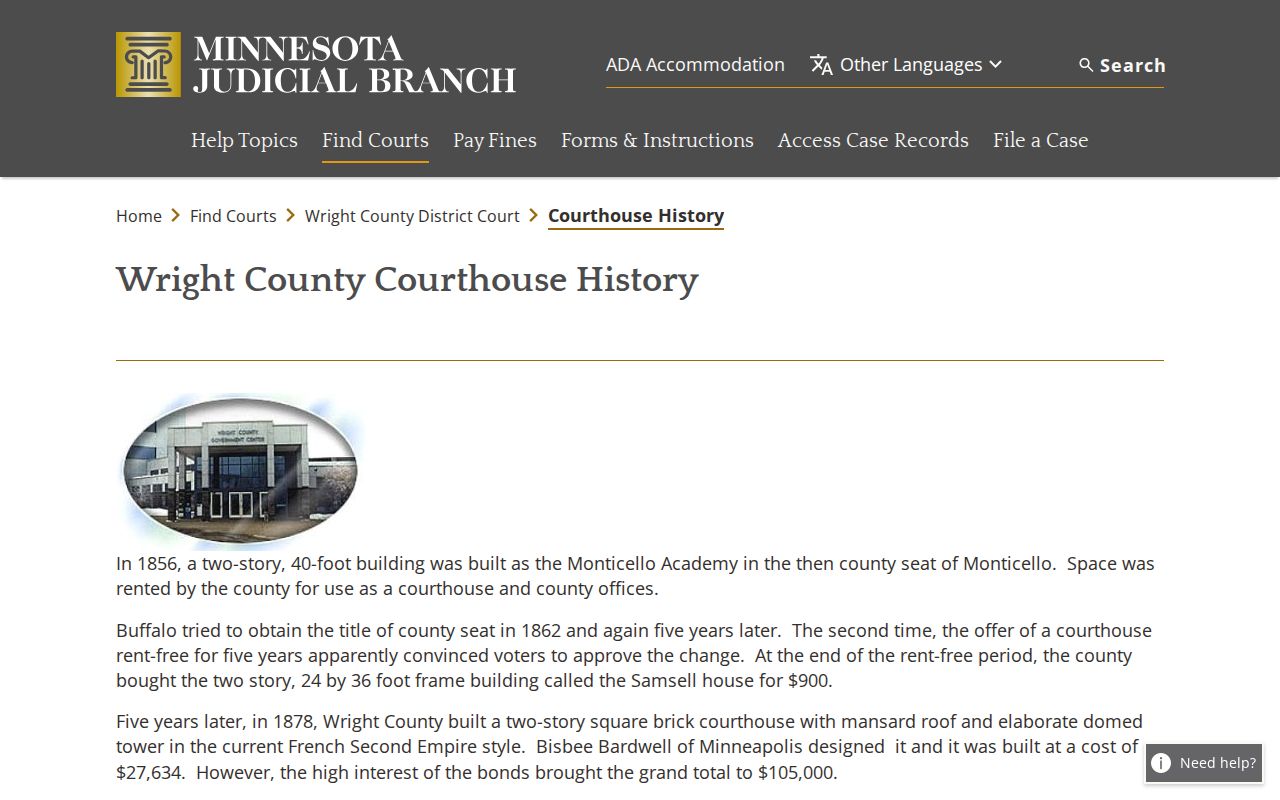
The courthouse history adds Buffalo context. Current Buffalo court records, though, are maintained by Court Administration at the present District Court location.